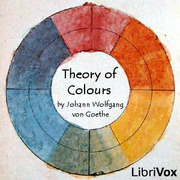
Newton's observations on the optical spectrum were widely accepted but Goethe noticed the difference between the scientific explanation and the phenomena as experienced by the human eye. He did not try to explain this, but rather collected and presented data, conducting experiments on the interplay of light and dark. His work was rejected as 'unscientific' by physicists but his color wheel is still used by artists today. - Summary by Lynne Thompson
Chapters
1 Translator's Preface and Preface to the First Edition 29 min 2 Introduction 16 min 3 Part I - Physiological Colours Section 1 - Effects of Light and Dark on the Eye 5 min 4 Section II - Effects of Black and White Objects on the Eye 14 min 5 Section III - Grey Surfaces and Objects; Section IV - Dazzling Colourless Objects 9 min 6 Section V - Coloured Objects 14 min 7 Section VI - Coloured Shadows 13 min 8 Section VII - Faint Lights; Section VIII - Subjective Halos 9 min 9 Pathological Colours - Appendix 14 min 10 Part 2 - Physical Colours - Section IX - Diotropical Colours 6 min 11 Section X - Diotropical Colours of the First Class 19 min 12 Section XI - Diotropical Colours of the Second Class - Refraction 8 min 13 Subjective Experiments - Section XII - Refraction Without the Appearance of Colour; Section XIII - Conditions of the Appearance of Colour 7 min 14 Section XIV - Conditions Under Which the Appearance of Colour Increases 5 min 15 Section XV - Explanation of the Foregoing Phenomena 12 min 16 Section XVI - Decrease of the Appearance of Colour; Section XVII - Grey Objects Displaced by Refraction 7 min 17 Section XVIII - Coloured Objects Displaced by Refraction 20 min 18 Section XIX - Achromatism and Hyperchromatism; Section XX - Advantages of Subjective Experiments. - Transition to the Objective 11 min 19 Objective Experiments - Section XXI - Refraction Without the Appearance of Colour; Section XXII - Conditions of the Appearance of Colour 9 min 20 Section XXIII - Conditions of the Increase of Colour; Section XXIV - Explanation of the Foregoing Phenomena 8 min 21 Section XXV - Decrease of the Appearance of Colour; Section XXVI - Grey Objects ; Section XXVII - Coloured Objects; Section XXVIII - Achromatism and Hyperchromatism 11 min 22 Section XXIX - Combination of Subjective and Objective Experiments; Section XXX - Transition 8 min 23 Section XXXI - Catatropical Colours 11 min 24 Section XXXII - Paroptical Colours 17 min 25 Section XXXIII - Epoptical Colours 30 min 26 Part III - Chemical Colours - Section XXXIV - Chemical Contrast 3 min 27 Section XXXV - White; Section XXXVI - Black; Section XXXVII - First Excitation of Colour 10 min 28 Section XXXVIII - Augmentation of Colour; Section XXXIX - Culmination; Section XL - Fluctuation; Section XLI - Passage Through the Whole Scale 9 min 29 Section XLII - Inversion; Section XLIII - Fixation; Section XLIV - Intermixture, Real; Section XLV - Intermixture, Apparent 11 min 30 Section XLVI - Communication, Actual; Section XLVII - Communication, Apparent 8 min 31 Section XLVIII - Extraction; Section XLIX - Nomenclature 13 min 32 Section L - Minerals; Section LI - Plants 10 min 33 Section LII - Worms, Insects, Fishes; Section LIII - Birds 13 min 34 Section LIV - Mammalia and Human Beings 16 min 35 Section LV - Physical and Chemical Effects of the Transmission of Light Through Coloured Mediums; Section LVI - Chemical Effect in Dioptrical Achromatism; 8 min 36 Part IV - General Characteristics 18 min 37 Part V - Relation to Other Pursuits 30 min 38 Part VI - Effect of Colour With Reference to Moral Associations; Yellow; Red-Yellow; Yellow-Red; Blue; Red-Blue; Red; Green 18 min 39 Completeness and Harmony; Yellow and Blue; Yellow and Red; Blue and Red; Yellow-Red and Blue-Red; Combinations Non-Characteristic; Relations of the Combinations to Light and Dark; Considerations Derived from the Evidence of Experience and History 19 min 40 Aesthetic Influence; Chiaro-Scuro; Tendency to Colour; Keeping; Colour in General Nature; Characteristic Colouring 15 min 41 Harmonious Colouring; Genuine Tone; False Tone; Weak Colouring; The Motley; Dread of Theory; Ultimate Aim; Grounds; Pigments 13 min 42 Allegorical, Symbolic, Mystical Application of Color; Concluding Observations 9 min